European Voluntary Service

This is Pekarna's blog for EVS volunteers. Pekarna is a sending and hosting/receiving organisation for EVS volunteers and their volunteers (send and hosted ones) will keep you up to date about their work.

Evropska prostovoljska služba

Pekarna Magdalenske mreže Maribor te vabi, da se tudi ti pridružiš množici prostovljcev/-k Evropske prostovoljne službe (EVS) in odpotuješ v organizacijo po svoji izbiri v drugo državo EU. Smo pošiljajoča in gostiteljska organizacija EVS, ki mladim od 17. in do 30. leta za obdobje največ enega leta uredi vse podrobnosti za brezskrbno in povsem brezplačno delovanje v tujini.
Evropska prostovoljna služba je del programa ERASMUS + Mladi v akciji.

Za bolj podrobne informacije nas lahko kontaktiraš na: evs@pekarna.org


Friday, 27 March 2020

February by Gilles

The first week of February opened with a meeting with Renato, a teacher from the Maribor High School of Arts and Design. This first meeting was very encouraging because we could imagine having different types of workshops with the students. Tuesday was the third episode of my French course. I concentrated my course on how to explain where I live and what my activities are. As usual, it is always a very enriching moment to learn pedagogical notions. I really find satisfaction in seeing the participants progress more and more at each lesson.

I spent my Wednesday thinking about a photo selection for my exhibition Wall(s). It was a difficult moment because I had to search through about fifty images and try to find a way to resume or create a link between them. It was a rather complicated exercise but in the end it was beneficial.

On Friday, we had a workshop about the LGBTQI+ cause for the international class. We talked about the inclusion of LGBTQI+ people in today's society and gave some cultural backgrounds for teenagers to discover and be more interested in gender issues. We tried to make the workshop take the form of an active discussion so that the young people could express themselves freely and exchange with us. It was a test moment, we have revised our presentation because unfortunately the children stayed quite passive.
On Friday evening I went to Ljubljana with some friends to participate in the MENT festival and it was a wonderful surprise. I discovered many music bands and saw some friends there again. I hope to be able to go to the 2021 edition.

To start the second week of February we did a workshop about physical activity with children with disabilities. We had with us a ping pong competition. On Tuesday, we repeated our workshop on LGBTQI+ issues at the Second Gymnasium in Maribor. This time the group was very active and we could talk about the difficulties of being on the outside of the hetero-normative society. The young people had many questions and we were able to talk easily with them. Some of them even volunteered for the Maribor Pride.

In the evening, we held a workshop for TOTI DCA, an association of elderly people, called: Healthy mind, Healthy food. The workshop intended to give some nutritional advice but also to raise consciousness around the manipulation of images. First of all, we made a test around nutrition issues with participants. The group was split in two and it was a time of many discussions and debating. Then we made a guacamole in front of the participants so that they knew how to make a simple and tasty meal. Finally, the last part was more oriented to the manipulation of information and images. We talked about the dangers of information on the internet, then we argued and showed, through historical and artistic cases, that it was very simple to modify images to deviate their meaning. The audience was very enthusiastic.

I've been looking all week for a way to print my photos. I spoke with Gregor Salobir from the GT22 to find a good printer in Slovenia. I finally called Luminus Studio in Novo Mesto and it was a great choice. On Thursday, we had an event around global warming with the broadcast of a Franco-German documentary.

The third week has been, I think, the busiest since I've been here. It was the week of preparation for my exhibition. I learned a lot from that experience. My photos finally arrived earlier than expected, on Monday. The first difficulty was to find a way to fix them, because the photos were glued on cardboard without any fixation. But we found a solution and this week was very rich. The first thing was to choose a scenography to give the visitor a feeling of reading, then the technical constraints arrived. We had to choose a height for the photos, print and glue the cartels, print the text of the exhibition's intention, manage the lights and make the space clean for the Friday evening vernissage. The vernissage was a very emotional moment for me because it had been a very long time since I had exhibited and I had the great pleasure of seeing many friends, colleagues and partners come to see my work. I received excellent comments and even gifts. I really didn't expect such a warm welcome. The most difficult moment for me was the speech in English. Once again, I would like to thank all the Infopeka team but also my friends, especially Natnada, for their help.


During this busy week, Lucas and I also participated in Rubrika: Filmopeka where we wrote and analyzed our first reviews. Lucas chose to review one of the movie he hated the most: Fast and furious 8 and I chose to review my favorite movie: Mysterious Skin. It was interesting to have Damijan's advice and encouragement. I also took part in the first meeting with Rajzerfiber around the festival of marches. With Filip and Lucas we want to propose a march around music. We chose several places in the city and associated them with pieces of music we like. I'm also going to take a walk around the Maribor walls that inspire my pictures.

I went to the carnival in Ptuj on the weekend. The Kurent chased away the winter spirits. Spring is coming soon. Ptuj is really a beautiful city, I hope to meet there again to discover the inside of the castle. I really liked the medieval atmosphere of the city. The costumes of the Kurent are impressive, I'm very happy to have been able to participate of the carnival.


The last week of February was quieter. We ended with the vegan meal, which is always very interesting. This time we watched a documentary about capitalism. I think veganism and anti-capitalism are intimately linked. It was, as usual, an excellent evening for his critical mind but also for his stomach.

Thanks for taking the patience to read my blog, see you in March for a special blog. A Coronavirus special edition
Gilles

Tuesday, 3 March 2020

January by Filip

Zdravo,
After holiday travels, I returned to Maribor to continue my ESC volunteering in Pekarna Magdalenske Mreže. For most of the time, we have been busy with the organizational meetings, application deadlines and writing grant reports for the projects and programs in 2020/21. The whole process was quite instructive, and I think I learned a lot about the workings and goings of NGO papyrology in EU. The whole experience makes me feel less eager to write my own projects, because most workers in cultural and educational sphere, I assume, would prefer to deal with content rather than papyrology, and I am one of them, but I guess those are just idle thoughts. 


Anyway, we’ve prepared GuestRoomMaribor Open Call for the 2020. GuestRoomMaribor (henceforth GRM) is artist-in-residence program in Maribor which is active since 2011. GRM is a delightful platform for international exchange of artistic and cultural content. GRM offers support and cooperation to local and international audience, as well as to other NGO’s by creating a common space between these actors in order to boost the sharing of experience and knowledge between each other. GRM streams to address contemporary issues by critically engaging with power relations in current regime, to question the role of art in these relations and to puts focus on the local culture and politics of Maribor throughout participatory, site-specific art projects and interventions.


Submission deadline for the GRM open call:  29th of February 2020. I am looking forward to meeting our incoming GRM residents!
Lep pozdrav!
Filip

Monday, 17 February 2020

How to be a French lover?

Here's a new year beginning. After a few days in France, I enjoyed coming back to my room in Maribor. We went back to work quietly. We discovered the new exhibition at Gallery K18. Thursday, we had the German course by Lucas. We started to think about a program around the Library Rosa Luxemburg for the coming months. We are going to have a program about feminism and activism.
The following week I had my first French class at INFOPEKA. It was very interesting to teach. I took a lot of time to work out a plan to teach the basics of French. The difficulty was that I didn't know the level of the people and I wanted to develop something lively. The participants seemed to enjoy this moment with me. I continue the French class that I entitled: How to be a French loveR? every two weeks. We also took our Slovenian test with Lucas and I am pleased to announce that we both have the A2 level of Slovenian. At the end of the week, we had a meeting with our coordinator to plan the actions until the end of the volunteering.

The third week of January, we watched Foxtrot during RUBRIKA: FILMOPELA, it was an interesting moment that ended with a philosophical debriefing about anti-militarism and utopia. I also started to work on the subject of my exhibition and write a text and a plan for the scenography. On Thursday, we went to the Second Gymnasium of Maribor to meet the coordinator of the international class of the establishment. We discussed the possibility of creating an awareness workshop on LGBTQI+ issues in February. Friday ended with the screening of the film MicMac: à tire l'arigot by Jean Pierre Jeunet and it was an excellent moment. The film was very critical and interesting.
The last week was our mid-term training with Lucas. The training took place in Velenje. It was very interesting to discover this city, a mining city where Tito had a great influence and importance. The training was very enriching. First of all, it was very pleasant to see the other ESE and to take stock of our situation. The proposed workshops were great. We visited the mine and it was a beautiful metaphor of the ESE experience.
See you in March for the February blog ;)

Friday, 14 February 2020

January by Lucas

January not only marks the start of a new year but also the halfway point of my trip as an ESC volunteer. This gave me an occasion to pause and look back over the past five months. In fact, it was an entire working week to look back on because the Slovenian national agency MOVIT invited me and other European volunteers to a midterm evaluation in which we analyzed and evaluated every aspect of the time we spent in Slovenia. In addition to a detailed reflection on what has already happened, important aspects of the next half of the ESC were also discussed. For example, which personal goals we still want to fulfill and which projects we want to implement. But also outside of the midterm evaluation, january was rich in events and activities. At RUBRIKA: FILMOPEKA, we are getting closer and closer to our first own film review, as we are constantly expanding our skillset. German classes are going just as well, conveying my knowledge gives me great pleasure. Although I have to add that it is very easy with participants to feel joy about it. Because in addition to zeal and curiosity, they also bring a lot of fun and good humor to the classes. Furthermore, the end of my Slovenian course turned out to be successful because I received a language certificate after passing the final exam. So at the end I can say that January was a good month for me.

baby Lucas :)

Tuesday, 11 February 2020

Prostovoljsko delo v Avstriji

Moje ime je Mojca in sem v začetku januarja 2020 pričela v okviru programa European Solidarity Corps (ESC) s prostovoljskim delom na projektu z imenom Intergenerational Living and Learning (Intergenerationall Lernen Erleben) v domu za ostarele v Herzogenburgu (Pflege- und Betreuungszentrum Herzogenburg). To je pilotni projekt, ki trenutno teče v Avstriji v treh različnih domovih za ostarele – v Mödlingu, Gloggnitzu in Herzogenburgu. V kolikor se bo izkazal za uspešnega, bo tovrstnih projektov v Avstriji še več, za kar se kaže izjemen interes. V trendu starajočega se prebivalstva se gradi in ustanavlja nove domove za ostarele, v katerih država poskuša nuditi kar se da visok življenjski standard. Prostovoljni delavci igramo pomembno vlogo pri izboljšanju kvalitete bivanja oskrbovancev in smo pokazatelj nadstandardne ponudbe.
Dom za ostarele v Herzogenburgu je bil zgrajen leta 1898, zadnjič saniran leta 1985 in bil leta 2012 po 3-letni popolni gradbeni prenovi na novo ustanovljen. V domu trenutno živi 108  prebivalcev. Poleg doma se nahaja tudi velik vrt z vinsko trto in sadnim drevjem ter varovanim delom za sprehajanje. V obliki črke T zasnovana zgradba ponuja v treh nadstropjih skupno 54 enoposteljnih in 27 dvoposteljnih sob s svojo kopalnico. V vsakem nadstropju se nahaja osrednji prostor s funkcionalno kuhinjo in sestrskim pultom, kateri spominja bolj na recepcijo v hotelu, kot pa na sestrski pult, za katerem se nahajajo čajna kuhinja, prostor z zdravili in delovna soba za zdravnika in posege. Da je asociacija popolna, se na njem seveda nahaja napis “Willkommen” in celo zvonček za priklic osebja. 
Na koncu vsakega izmed treh hodnikov, ki vodijo iz osrednjega prostora, se nahaja manjša, v celoti opremljena kuhinja z veliko teraso. Poleg centralne kuhinje, ki se nahaja v pritličju in katera pripravlja hrano za prebivalce doma ter oskrbovana stanovanja, ki se nahajajo v sosednji stavbi, se v vsakem nadstropju nahajajo še 4 kuhinje, ki nudijo možnost samostojne priprave hrane. V pritličju najdemo garderobo in prostore osebja, 2 manjši dvorani za seminarje, soba za umetniško ustvarjanje, pralnico, večji družabni prostor s kavarno in nekatere druge storitve (fizioterapija, pedikura, frizerski salon, kapela ter poslovilni prostor).

Moj delovni dan se prične ob 8ih zjutraj z zajtrkom, kjer pomagam pri hranjenju. Čas po zajtrku (med 9.00 in 10.00 uro) služi za pripravo na dopoldanske aktivnosti in organizacijo. Prebivalce doma pospremim do kraja, kjer se odvija aktivnost, pri kateri tudi sama sodelujem, in jih ob koncu vodim nazaj v pravo nadstropje. Velik del oskrbovancev ima namreč velike težave bodisi z gibanjem, bodisi s pomnjenjem in orientacijo. Urnik dopoldanskih aktivnosti je v domu polno zaseden – skupinska telovadba, družabne igre, likovno ustvarjanje, oblikovanje izdelkov iz gline, petje ob glasbeni spremljavi, enkrat tedensko v dopoldanskih urah pride na obisk tudi skupina predšolskih otrok, s katerimi oskrbovanci pojejo.

Ob 11.00 uri se dopoldanske aktivnosti zaključijo in ob 11.30 je čas za kosilo, kjer ponovno pomagam pri razdeljevanju hrane, hranjenju in pospravljanju. Svoje kosilo pojem skupaj z ostalimi sodelavci med 12.30 in 13.00 uro. Med 13.00 in 16.00 uro je čas za popoldanske aktivnosti.


Kljub temu da večina zaposlenih zaključi s službo in zapusti dom, je na voljo kar nekaj aktivnosti – urjenje spomina skozi spominjanje preteklosti, reševanje preprostih miselnih nalog, branje v skupini, peka slaščic, pasji trening (sledenje), sprehodi in pogovori. Poleg tega se dom napolni s sorodniki in drugimi obiskovalci.

Sama delam 30 ur tedensko. V prvi polovici januarja sem delala vse delovne dni do 14ih in velikokrat ostala dlje kot potrebno. Ker je moj delovni čas fleksibilen željam, sem zato svoj delovnik prilagodila na 4 delovne dni tedensko (8 delovnih ur v ponedeljek, torek in sredo ter 6 delovnih ur v petek). V drugi polovici januarja in z začetkom februarja pričenjam tudi s svojimi samostojnimi aktivnostmi – skupinska telovadba, likovno ustvarjanje iz različnih materialov, trening spomina, namizne igre in branje.


Prehrano imam urejeno v domu za ostarele (zajtrk, kosilo in večerja, katero ob koncu delovnega dne odnesem s seboj domov). Poleg spletnega jezikovnega tečaja OLS, mi dodatno gostujoča organizacija financira še klasičen tečaj na inštitutu za gospodarski razvoj WIFI (Wirtschaftsförderungsinstitut NÖ). Kljub temu, da dobro znam nemško, je komunikacija v nemščini v Avstriji kar otežena, toliko bolj s starejšimi. Dialekt, narečje oziroma “Mundart” je zelo močan in z razumevanjem imam velike težave. Sodelavci (katere moram pohvalit, da že zelo dobro izgovarjajo moje ime :D) se morajo včasih kar potrudit, da najdejo pravilne izraze v knjižni nemščini oziroma “Hochdeutsch”. Na svoj račun se znajo šalit, da se bodo v času mojega prostovoljstva tudi oni malo spet učili nemščino. Pri delu z oskrbovanci pa se moram včasih poslužiti drugih metod komunikacije. S strani gostujoče organizacije je poskrbljeno tudi za mojo nastanitev in mesečno karto javnega potniškega prometa, katera velja za mestni in regionalni avtobusni promet in vlak. Za prihod na delo v Herzogenburg z avtobusom ali vlakom potrebujem 15 min, do koder so dobre povezave iz bližnjega mesta St. Pölten, kjer bivam v svojem stanovanju. Avtobusno in glavno železniško postajo imam v neposredni bližini. Z bivanjem na obrobju centra mesta, ki je največje in od leta 1986 glavno mesto zvezne dežele Spodnja Avstrija (Niederösterreich), se tako večina pomembnejše infrastrukture zdi v bližini. Po velikosti in številu prebivalcev bi ga lahko primerjali s Celjem. 

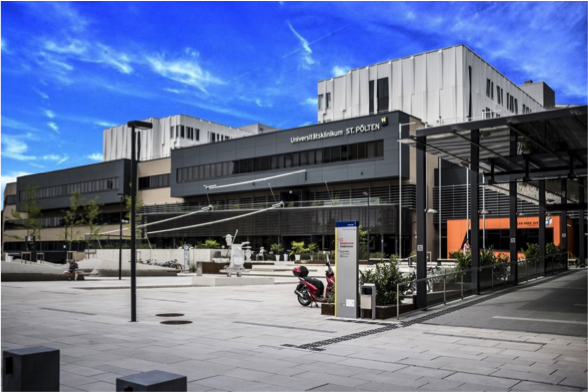
V zaključku prispevka naj omenim še nekatere pokazatelje splošnega stanja mesta oziroma države. Kljub temu, da zdravstvene oskrbe v času svojega bivanja v Avstriji še nisem potrebovala, sem privoščila obisk Univerzitetnemu kliničnemu centru St. Pölten, kateri velja za eno izmed modernejših klinik v Evropi. Zvezna dežela Spodnja Avstrija (Niederösterreich) je v izgradnjo skupne infrastrukture centra vložila več kot 510 milijonov evrov, v želji ostati v koraku z razvojem zdravstvene oskrbe.

Omenjenemu prestižu javnega značaja se ob bok lahko postavijo še avstrijske železnice (Österreichischen Bundesbahnen, ÖBB). Zaradi zelo dobrih povezav, je obisk drugih avstrijskih mest iz St. Pölten-a zelo olajšan. Razen v časovnem oknu od 1ih do 5ih zjutraj je vsako uro na voljo več vlakov (4-6 vlakov), ki vozijo z Dunaja v smer St. Pölten-a. V obratno smer je časovno okno mirovanja prestavljeno med polnoč in 4to uro zjutraj. Veliko ljudi, živečih v  St. Pölten-u in zaposlenih na Dunaju, vsakodnevno uporablja železniški potniški promet, saj pot traja med 30 in 60 min, odvisno od vrste vlaka. Tako na vlakih, kot tudi na železniški postaji je na voljo brezplačen internetni dostop. Poleg tega je z ozirom na starostno skupino pri železnicah možno kupiti ustrezno kartico popustov. Sama imam ÖBB Vorteilscard 66, s katero imam 50% popust na vse vožnje in katero nam prostovoljcem v Avstriji finančno krije nacionalna agencija.


Kulturni program v mestu je skromen, pa vendar prisoten. V januarju sem spoznala kulturni projekt z imenom “Alle tanzen”, organiziran s strani Festspielhaus-a. Izmed vseh prijavljenih plesnih laikov, so na avdiciji izbrali 150 navdušencev. Več o projektu in ustanovi najdete na spletu, tiste najbolj zvedave pa vabim v začetku junija v St. Pölten, da si naš nastop ogledate v živo.

Se še beremo...

Mojca